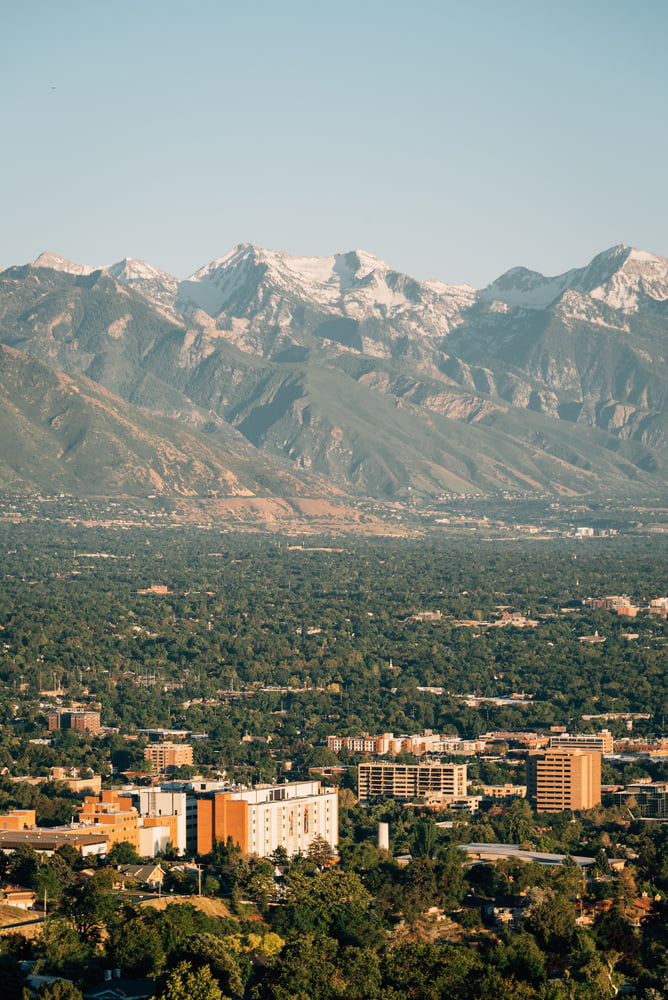
A city overview of Salt Lake City and the Wasatch Mountains.
As local attorneys serving Salt Lake County, we know that busy roads require careful attention. Dense traffic, turning vehicles, commercial driveways, and changing speeds can create conflicts at intersections and interchanges.
Knowing what to watch for can help you prepare. Here are five locations across the Salt Lake Valley and practical tips for navigating them safely.
For readers researching the most dangerous intersections in Salt Lake City, this guide describes traffic conflicts at five locations in the wider Salt Lake Valley, including Murray and the Taylorsville area. It is not a statistical ranking. Traffic patterns and road conditions can change.
1. State Street & 4500 South
In Murray, this intersection serves nearby retail destinations and commuter routes.
Commercial traffic: Vehicles entering and leaving businesses add turning movements to the corridor.
Multi-lane turning conflicts: Crossing several lanes or changing lanes near an intersection requires a clear view and careful judgment.
Safety tip: Watch for vehicles entering from driveways, choose your lane early, and leave extra stopping distance.
2. Redwood Road & 5400 South
This Taylorsville-area junction connects commuter traffic with commercial destinations.
Turning conflicts: Drivers need to account for oncoming traffic and nearby driveway movements.
Signal changes: Rushing a changing light can create a conflict with traffic entering from another direction.
Safety tip: Obey the signal, wait for a safe turn, and check cross-traffic before entering on green.
3. Redwood Road & 4100 South
This location is part of the Redwood Road corridor in the Taylorsville area.
Multi-lane traffic: Turning and lane changes can be difficult when other vehicles block a driver's view.
Pedestrian vulnerability: Drivers should watch carefully for people crossing a wide roadway.
Safety tip: Follow pedestrian and traffic signals, avoid distractions, and leave space for other road users.
4. Bangerter Highway & 5400 South
Bangerter Highway and 5400 South meet at a freeway-style interchange. UDOT lists the 5400 South interchange among its completed Bangerter projects.
Ramp and cross-street movements: Through traffic, entering and exiting vehicles, and traffic on 5400 South follow different paths.
Changing speeds: Pay attention to posted speeds, ramp signs, lane markings, and cross-street signals.
Safety tip: Pick your lane early, follow the signs for your route, and avoid last-second lane changes.
5. 2100 South & 1300 East
In Salt Lake City's Sugar House neighborhood, this intersection combines vehicle travel with access to shops, homes, parks, and other destinations.
Turning and access conflicts: Drivers should account for turning vehicles and people entering or leaving nearby destinations.
Pedestrians and cyclists: Check crossings and sidewalks before beginning a turn.
Safety tip: Yield as required, put away distractions, and check crosswalks again before moving.
What to Do If You're Involved in an Intersection Accident
Even cautious drivers can be involved in a crash. If you or a family member are injured in a traffic accident in Salt Lake County:
Check for injuries and call 911: Request emergency help when anyone is injured or there is an immediate danger.
Document the scene safely: If it is safe to do so, photograph vehicle positions, intersection signals, road conditions, and visible injuries. Do not put yourself in traffic to take photos.
Exchange information: Obtain contact and insurance information from the drivers involved and contact information from witnesses.
Seek medical care: Some injuries may not be apparent immediately. Get medical attention for symptoms or concerns and follow your clinician's advice.
If you or a loved one has been injured in an intersection collision in Salt Lake City or the surrounding areas, you don't have to navigate medical bills, lost wages, and insurance claims alone.
Disclaimer: The information provided in this article is for general informational and educational purposes only and does not constitute legal advice. Past results do not guarantee future outcomes.